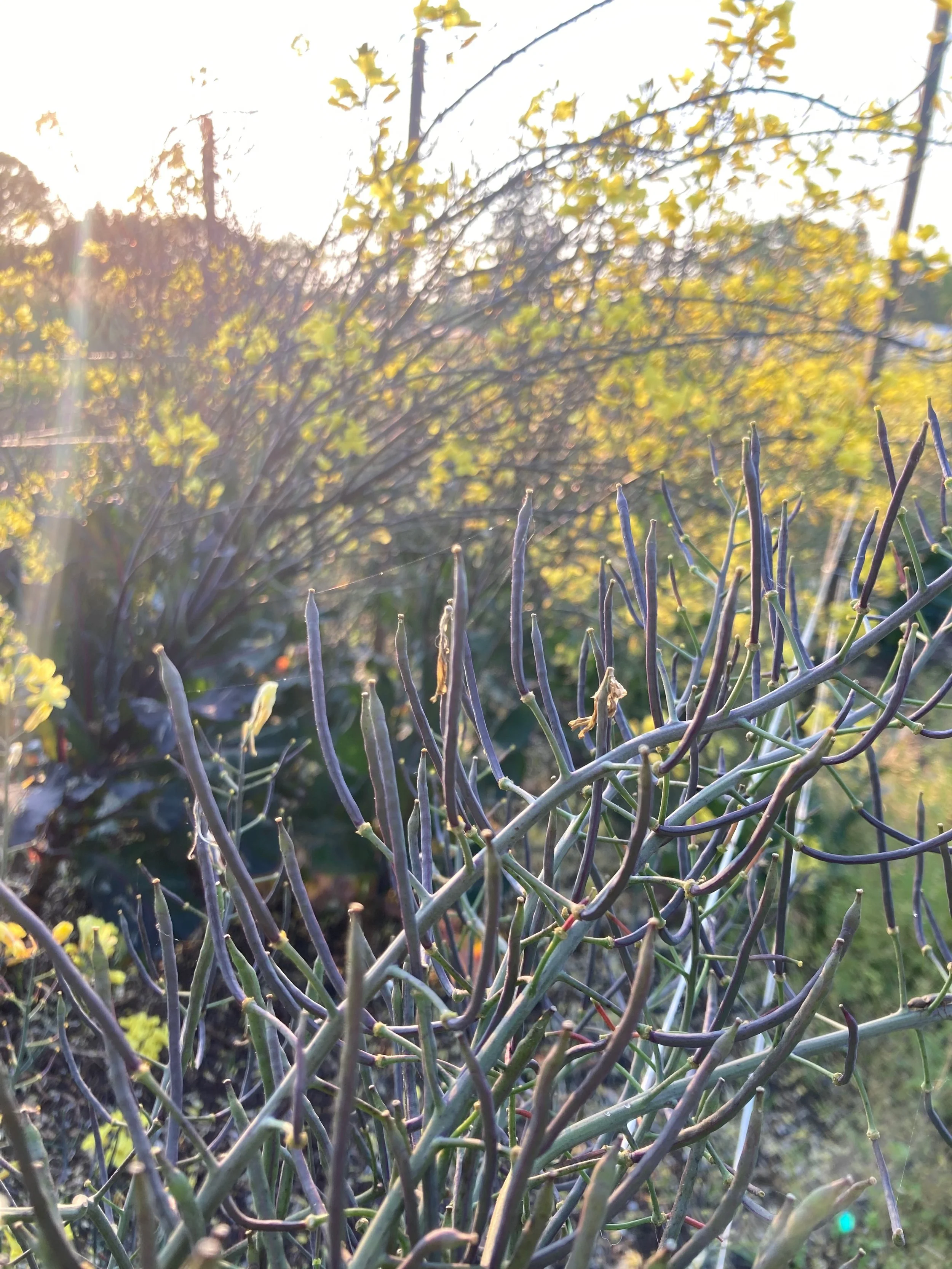
Our work with seeds is focused on three primary objectives—preservation, adaptation, and diversification.
We grow seeds that are adapted to our region and resilient in the face of increased weather, disease, and pest pressure as a result of climate change. We believe that seed access and knowledge is critical for the future of food security and sovereignty, and accordingly that educational programming and community- and coalition-building is critical in those efforts. We care for seeds and participate in the dispersal of open-pollinated, patent-free seeds using myriad strategies with the end goal of seeds embedding themselves in communities that will continue to grow and care for them.
-
The survival of any crop depends on seed being stored safely and grown out and multiplied regularly. Without this stewardship, varieties risk being lost and forgotten.
Preservation for us concerns seeds on the precipice—primarily those of significance for our region, as well as those belonging to communities in diaspora and/or under threats of genocide and cultural erasure. We offer safe storage for seeds and a temporary or long-term home and care, as well as technical and educational support to the next generation of growers and stewards with the goal of seeing these seeds once again rooted in community foodways.
-
Crop breeding within modern industrial agriculture generally takes a “one size fits most” approach to seed production. Seeds that have been bred in high-input, highly controlled systems perpetuate the dependence of the resulting crops on those same techniques and inputs to thrive, and cannot comprehensively serve the diverse needs of growers operating outside these systems.
In contrast, we care for seeds by encouraging a “good constitution”. These seeds are widely adapted to the challenges of localized conditions, without dependence on high inputs and crop protection chemicals, and with enough inherent diversity to continue adapting and evolving. We count ourselves among a growing global effort to increase the resilience and place-based specificity of food crops, which involves a mosaic of different approaches. For us, this looks like growing seeds in holistic systems of farming, including low-input systems and a centering of biodiversity. In the context of a rapidly changing world and climate, we need seeds with the capacity to adapt alongside us as we navigate the world to come.
-
Our efforts in diversification are two-fold: varietal and genetic. The more diverse the genetics of a particular variety, the more capacity it has to adapt and evolve; the more diverse the spectrum of varieties, the wider the range of choices available to anyone growing food.
When we look at the changes in the diversity available to farmers and growers over the last century, we see that the massive consolidation within the seed industry has paralleled a trend in the increase of various forms of intellectual property restrictions—and consequently a dramatic decrease in agrobiodiversity. Our work in diversification involves growing genetically diverse populations of crops, and increasing the varieties available to farmers in our region. Ultimately, we want seeds and the means of their reproduction in the hands of the people growing them. It is because of the work of past seed keepers that the heirlooms of today exist, and it’s through the proliferation of diversification and community seed sovereignty that possibility exists for heirlooms of the future.